We Do Not Live in the Present
What a near-accident revealed about the brain’s construction of “now”

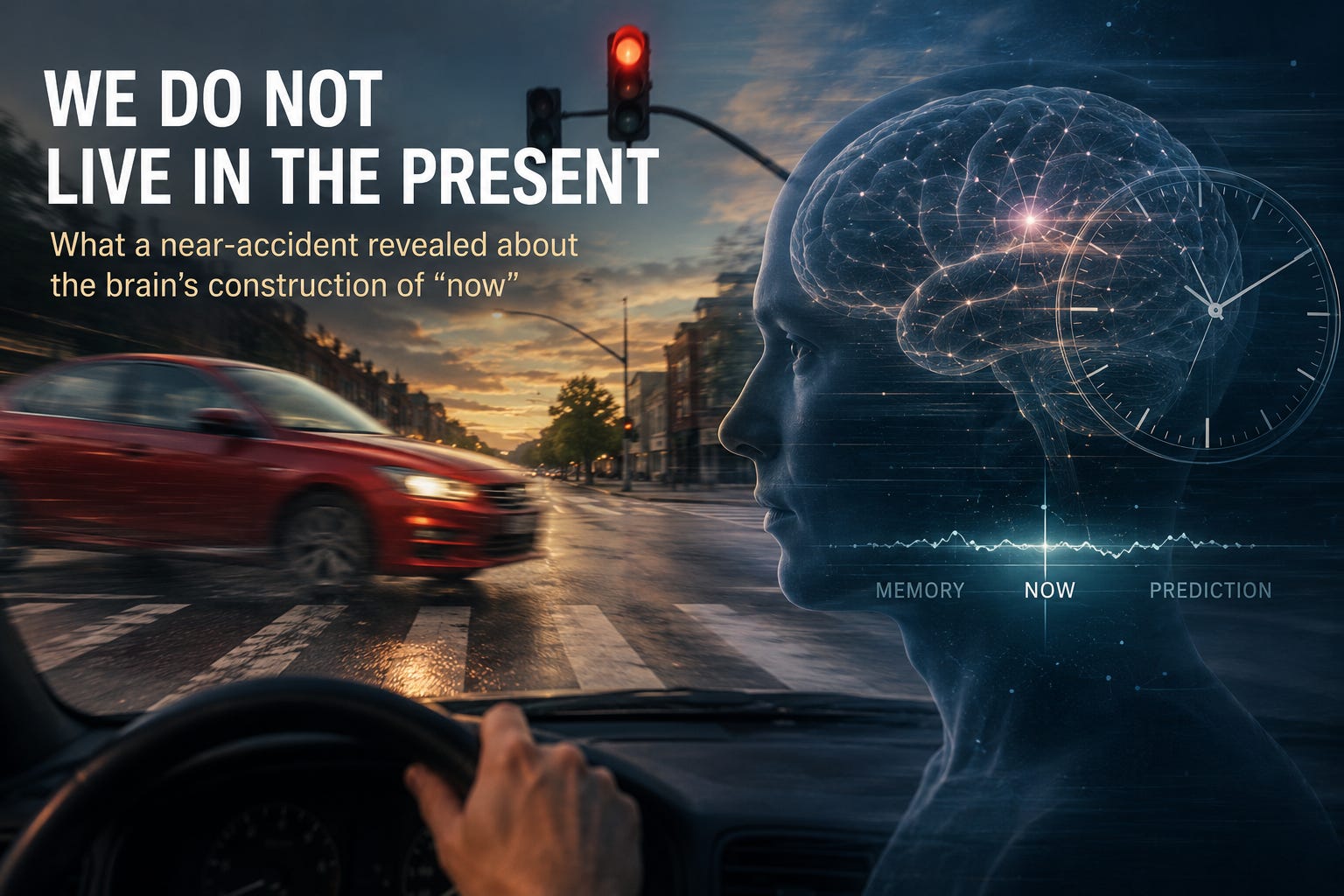
A car came through the side of the intersection against a red light, and time changed.
I do not mean that I panicked, or that adrenaline sharpened me. I mean something more specific and stranger. The car seemed to arrive slowly. I could see its line, and I could see the gap beside it — the narrow space where the road was still open. I moved into the gap. The collision did not happen.
The fear came afterwards. During the event itself there was no fear, and, oddly, no thought. No voice saying this is dangerous. No story at all. There was only geometry: object, trajectory, gap, action. The narrator who normally runs in my head — the one who comments, worries, decides — was simply not there. Something faster had taken the wheel.
It took me years to understand what that moment was showing me. It was not really about the car. It was about the thing the car interrupted: the ordinary, invisible machinery that produces the feeling of living in the present.
Because here is the claim this essay is built on, and it sounds wrong the first time you hear it.
We do not live in the present.
The present is not an instant
We assume that “now” is the one thing we have direct contact with. The past is memory, the future is imagination, but the present — surely the present is just reality, arriving.
It is not. The present, as the brain delivers it, is a construction, and a delayed one.
Consider what has to happen for a single ordinary moment to exist. Light reaches the eyes. Sound reaches the ears, travelling far slower than light, arriving later. Touch and pressure travel up the nerves from the skin. The vestibular system reports gravity and motion. Proprioception reports where the limbs are. These signals do not arrive together, and they do not process at the same speed. A clap you both see and hear sends two streams to the brain that begin out of step.
And yet you do not experience the world as a smeared, desynchronised mess. You experience a single, smooth moment in which the hands meet and the sound happens together.
To produce that, the brain has to wait, gather signals that arrived at different times, synchronise them, correct them, and assemble them into one usable scene. By the time you consciously experience “now,” the events in it have already happened. The assembly takes time, and that time has a cost.
What we call now is already edited. We do not live in the present. We live in the brain’s best reconstruction of the immediate past.
Memory plus prediction
If perception were only reconstruction of the past, we would always be too late. A creature that acted purely on what already happened would never catch a ball, cross a road, or finish another person’s sentence. The lag would be fatal.
So the brain does something else as well. It predicts. It runs a constant model of what is about to happen next and acts on that model, correcting when the world disagrees. Much of what you feel as direct perception is actually prediction that has not yet been contradicted.
This gives a simple, strange formula for the lived present:
Present = memory + prediction.
The moment you inhabit is a negotiated boundary between a reconstruction of what just happened and a forecast of what is about to. It is not contact with the world as it is. It is a model, tuned closely enough to reality to keep you alive, and updated fast enough that you never notice it is a model.
None of this is mystical, and none of it is fringe. In one form or another it runs through a good deal of contemporary work on perception: the old idea of the “specious present,” the windows over which the brain integrates separate senses into one event, the broad framework of predictive processing, and the strange experimental cases of postdiction, where something that happens slightly later changes what you report having perceived slightly earlier — as if the brain quietly back-dated the edit. I want to be careful here: these are active areas, not settled equations, and I am borrowing their shape, not claiming their certainty. But the direction is hard to avoid. The present is built, not received.
In ordinary life, the construction is invisible, for the same reason the ground was invisible in the first of these essays: it does not fail. The world changes slowly enough. The floor stays where it was. The conversation unfolds at a human pace. The model and the world stay matched, and the seam never shows.
And then, occasionally, the world moves fast enough to stress the system — and the seam shows.
When time becomes geometry
That is what the intersection was. Not a glimpse of another reality, but a moment when the ordinary construction of “now” was pushed to its edge and started behaving differently.
In that state, the brain seems to drop everything it can afford to drop. The narrating self is expensive and slow, so it goes first. Language goes. The sense of I am the one this is happening to goes. What remains is the part that computes survival: position, motion, the opening, the act. The world stops being a set of named objects and becomes a field of moving probabilities. You do not respond to where things are. You respond to where they are about to be.
I recognised it, later, from somewhere unexpected. As a teenager I did some karting, and racing has a milder version of the same mode. You do not react to the car ahead; you read its line and move through the space it is about to vacate. You feel a gap close before it has closed. Good drivers are not faster at reacting to the present. They are living a little further into the predicted near-future than everyone else on the track.
This suggests something worth saying carefully. The famous sense that time “slows down” in an accident may not be the present stretching at all. It may be the reverse: under threat, the brain records far more densely than usual, laying down detail at a rate it never normally bothers with. The slow-motion may not be in the moment. It may be in the memory of the moment, reconstructed afterwards from an unusually rich recording. I cannot prove which it was in my case. But the distinction matters, because it keeps the strange experience inside the machinery of perception rather than outside it.
And the late arrival of fear fits the same picture. Fear is a story the body tells — that was dangerous, that could have ended badly — and stories take time and a narrator. Inside the event there was no narrator and no time to spare for one. The fear could only arrive once the danger was over and the slow self came back online to read the recording.
Inside the event, there is only geometry. Fear belongs to the body afterwards.
What the present was holding
I began the first of these essays with a claim that sounded like wordplay — we see in 3D, but we live by the ground — and found that the ground was a hidden support of ordinary experience, invisible only because it never failed.
The present is the second one.
The feeling that you are in direct, immediate contact with reality — that now is simply given, the one solid thing beneath all the uncertainty — turns out to be a support of the same kind. It is produced. It is a continuous act of assembly, running just beneath awareness, stitching delayed signals into a smooth moment and patching the gaps with prediction. It feels like bedrock for one reason only: under ordinary conditions it never misses a beat.
Push it — with a car through a red light, with speed, with threat — and the construction shows its edges. Not by breaking into something mystical, but by doing visibly, clumsily, what it normally does invisibly and well.
I did not come away from that intersection believing that time is an illusion, or that I had seen behind the curtain of reality. I came away with something smaller and harder to shake: the present I live in is not the world touching me directly. It is the closest, fastest, most convincing model the brain can build of a world that has, in truth, always already happened.
The ground was the first support. The present is the second. There are others — the quiet certainty that a familiar street is familiar, the steady sense that I am here behind these eyes. Each feels like reality itself. Each, I suspect, is a support of the same kind: invisible while it works, visible only when it fails.
But those are other failures, and other essays.
Human 2.5 is not about extraordinary experiences. It is about the hidden supports of ordinary experience — and what becomes visible when they fail.
Fascinating!